
Scott Trench
U.S. Healthcare costs continue to be the Early Retirement Bogeyman, and a bipartisan failure that perverts the balance of power between US companies and US workers.
The key headlines for 2027:
- Benchmark ACA premiums rose another 11% in HealthCare.gov states and 13% nationwide, following 2026’s roughly 26% national increase. That’s about $703/month for a 40-year-old, or $8,436/year.
- As a result, those who qualify for, or have the option to qualify for, Premium Tax Credits and MAGI planning are now a dominant Tax Planning Variable:
- Stay under the 400% Federal Poverty Line Cliff to remain eligible for subsidiesEven while under the cliff, understand that as MAGI decreases, premium tax credits increase up to the full cost of the planNew State specific edge cases and options are springing up or evolving in ways that matter greatly to specific groups (Includes at least CA, CO, CT, MD, NM, RI, and VT)The repayment caps on Advance Premium Tax Credits (APTC) have been eliminated (effective 2026+).
- In some mildly good news, effectively all Bronze ACA plans are now HSA compatible – and HSA contributions are a direct offset to MAGI.
- Those who don’t quality for PTCs are left with several bad options that we will discuss later, including:
- Go with an ACA plan (without tax credits)
- Go with a “Catastrophic Plan”
- Go without Insurance
- Go with an “Alternative to Insurance” like a HealthShare
- Go back to work
If you’d like to understand how costs work this year for ACA compatible plans, and see my updated projection tool incorporating 2027 data, the (completely free) 2027 Healthcare Cost Projection is now live.
I made some meaningful updates, including populating it with 2027 plan data (of course) and also greatly expanding the “Subsidy Dial” module, which now incorporates not just Federal Premium Tax Credits, but State credits (if they apply), and CHIP (if it applies).
I kind of went a little off the deep end here, but I think that the educational value of the new module is worth it, for those in states where state credits matter, for those with kids near the “CHIP” cliff (below certain income thresholds, children in certain households may become eligible for Medicaid benefits).
See how the new slider works for Connecticut, for example, below:
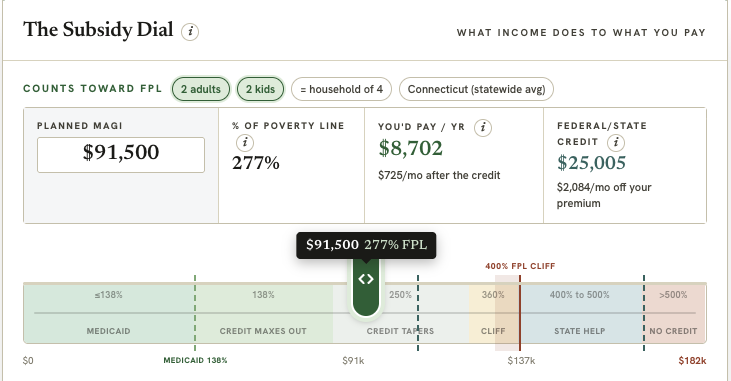
I think grasping a) the Federal cliff and how it is reflexive to household size, b) that subsidies increase as income decreases, even below the cliff, and c) that there are lots of very material edge cases is more important than ever for those in the FI community or the self-employed world.
For FIRE and self-employed households that can qualify, I expect managing modified adjusted gross income (MAGI) to dominate 2027 tax planning.
What’s Next for Healthcare Costs? 2028 and Beyond:
While these costs and the continued large-scale failure of American healthcare are shocking, frustrating, and anger-inducing to many, there really weren’t any major surprises. This played out almost exactly as forecast by major outlets like KFF reported in the summer. The Congressional Budget Office Expects Premiums to increase between 7% and 8% per year through 2034, and expect that growth rate to get there by being higher in the next few years, and lower as we approach 2034.
There is no mystery going on here. As premiums rise, and as more people are hit with full price, unsubsidized, or partially subsidized insurance, healthy people simply leave the insured pool. This “death spiral” (or close approximation – some still feel “death spiral” is too extreme) leaves the remaining insured pool sicker and higher risk, which forces premiums up, which perpetuates the cycle.
This is not particularly challenging to model for those paying attention, and not a difficult annual forecast.
The thing that makes this so difficult to forecast or plan on is the rising likelihood of policy change:
This spiral can only spin so many times. No one knows if it will spin for 5 more years, 10 more years, or if reform will come next year (2027) with the power transition in Washington. It may come after the Presidential election in 2028 and inauguration in 2029. We also don’t know which of several credible specific policy proposals are likely to be enacted, the mechanics of those proposals for self-employed or early retirees, or what tradeoffs new healthcare legislation would bring (possibly lower costs, but at the price of higher taxes paid by… someone).
If I was forced to make a bet, I’d bet with low to medium confidence that a proposal brought by Democrats socializing some portion of healthcare will come to pass, with new taxes on high income earners, and that this will be enacted in 2027-2028 (in partnership with Trump / Republicans – low probability) or 2029-2030 (if Democrats win the White House).
I’d bet with very high confidence that the Republican policy of “complain about Obamacare” will continue uninterrupted until new legislation is passed by Democrats.
Regardless, this “Death Spiral” and the legislation that gets enacted to address it are now a major variable in early retirement planning, and that should make people cautious.
Five Bad Alternatives For Those Who Don’t Qualify for Premium Tax Credits:
As discussed earlier, those who don’t quality for PTCs are left with several bad options:
- Go with an ACA plan (without tax credits)
- Go with a “Catastrophic Plan”
- Go without Insurance
- Go with an “Alternative to Insurance” like a HealthShare
- Go back to work
1. Going with an Unsubsidized ACA Plan:
In some cases, paying the full ACA premiums aren’t that big a deal, and will meet or potentially even come in lower than expected in 2027 for certain households. A family like mine (two 35 year old adults and two children under 5) will pay ~$14K in unsubsidized premiums in a state like New Hampshire, or $~17K in my state of Colorado.
This is expensive relative to the rest of the world, but anyone planning for lower premiums than this in early retirement (without subsidies) for a family of four has been living under a rock.
2. Going a “Catastrophic Plan”:
A lot of FI community members really like the idea of a Catastrophic Plan. If offered the option for a fictional “Catastrophic Plan” where I could pay MUCH lower premiums (like $500 per month for my family instead of $1200), and ONLY get coverage in the event that I had a truly terrible year (like $25K, or $50K deductible), I’d sign up immediately.
Sadly, this ficitional ideal exists only in imaginations. “Catastrophic Plans” as they actually exist are only about 10% cheaper than bronze plans, require you to be priced out of bronze plans based on your income, or meet certain other niche requirements, “only” increase the deductibles by a few thousand dollars, and have a MASSIVE drawback:
Catastrophic Plans are NOT ELIGIBLE FOR PREMIUM TAX CREDITS.
Because of this, very few individuals go with Catastrophic Plans. I expect that number to increase modestly from 2026 to 2027, as certain healthy households who are extremely confident they will not receive Premium Tax Credits will opt for the small savings.
This is a niche option, but because bronze premiums increased so much, the number of people who are eligible for such plans will swell, and there will be a small uptick.
Catastrophic plans, by the way, are now also HSA-compatible.
3. Going without Insurance:
At some point, this becomes a serious (and seriously uncomfortable) option. Let’s use a very real, and very extreme, example of a household in West Virginia, with two adults aged 60. Their cheapest ACA plan premiums, unsubsidized, are $44,106.
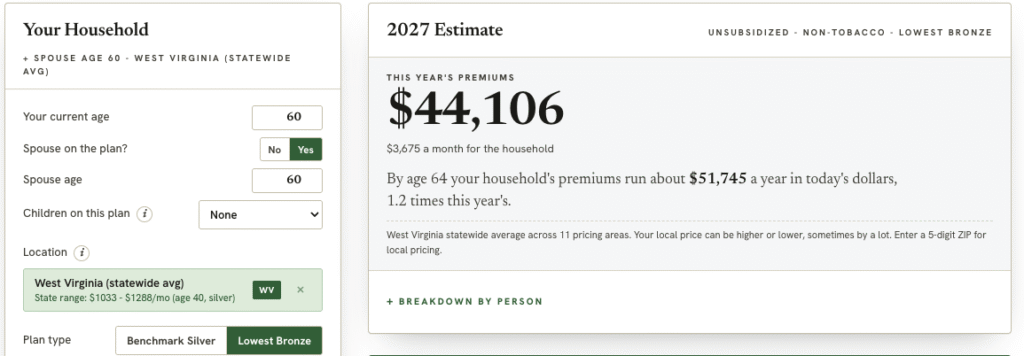
If they are unable to qualify for subsidies, at some point, this household begins to do the math on self-insuring. If they are generally in good health, they will hate it, but they may conclude, and reasonably so, that they have to risk it.
I hate this option, but it has to be exposed before we get into the next, controversial option.
4. Going with an “Alternative to Insurance” Like a HealthShare:
Very little in personal finance is as controversial, or as immediate a turn-off to some, as HealthShares. Yes, they don’t cover pre-existing conditions. Yes, they are not insurance, not regulated, and not obligated to pay. Yes, you can find horror stories. Yes, if you go with a HealthShare, you should be uncomfortable, and understand that you are taking a serious risk.
But, once you seriously consider going self-insured, HealthShares all of the sudden appear to many to be a middle ground.
At this point, I am really unable to opine on this option from an actuarial standpoint.
I can make the case that HealthShares have fraud, “claims denial” (they use different language than “claims” because they are “not insurance”), and solvency questions.
I can also make the case that traditional insurers have fraud, and claims denial, though I am more confident in their solvency.
I am completely unable to make an actuarial case for, or against, them. If a 20 passionate FIRE sub redditors downvote someone suggesting a Healthshare, I can’t argue with them. I also can’t disprove the guy passionately recommending the HealthShare.
The fact that this is completely unprovable as a risk relative to the cost and risk of traditional insurance should give both proponents and opponents pause. The answer is unknowable at this point and anyone claiming otherwise is simply wrong. Insurance itself cannot be justified at any price. A HealthShare cannot be reflexively dismissed relative to terrible insurance options.
The decision to go with a Healthshare or other alternative to traditional insurance is a risk/reward analysis, and we are simply missing information to accurately make this decision.
5. Going Back to Work
Expect this to be a major lever. Expect people to spend a few decades chasing Financial Independence and then start a business, or go back to work, with Health Insurance being a major driver of the decision.
Conclusion:
Health Insurance is the Early Retirement and American Dream Bogeyman right now. Costs are exploding, and managing a low income tax credit is unironically the number one financial planning variable for multimillionaire retirees.
It’s relatively straightforward to project spiraling cost increases until policy evolves, and because of that relative ease, the base case must be for a system reset with unknowable tradeoffs to hit within the next 10 years, and probably within the next 5.
In the meantime, I still believe that the responsible thing to do is to model out the full cost of health insurance under today’s law, and bake that into an early retirement or self-employment plan.
In my view, until we have a concrete proposal, that is likely to pass Congress, this is the only fact we can base projections on today.
Leave a Reply